
»How does a nymph feel?«
A studio conversation with Banu Birecikligil about inner landscapes, severed hands and the consciousness of lizards
For thirty years, Banu Birecikligil has been painting dreamscapes in which humans, animals, and myth overlap: humans encounter mermaids, whales, lions, and cats; lizards appear alongside nymphs and satyrs; and representations of the artist herself emerge again and again. Her forests, vegetation, and cities are less real places than states of consciousness.
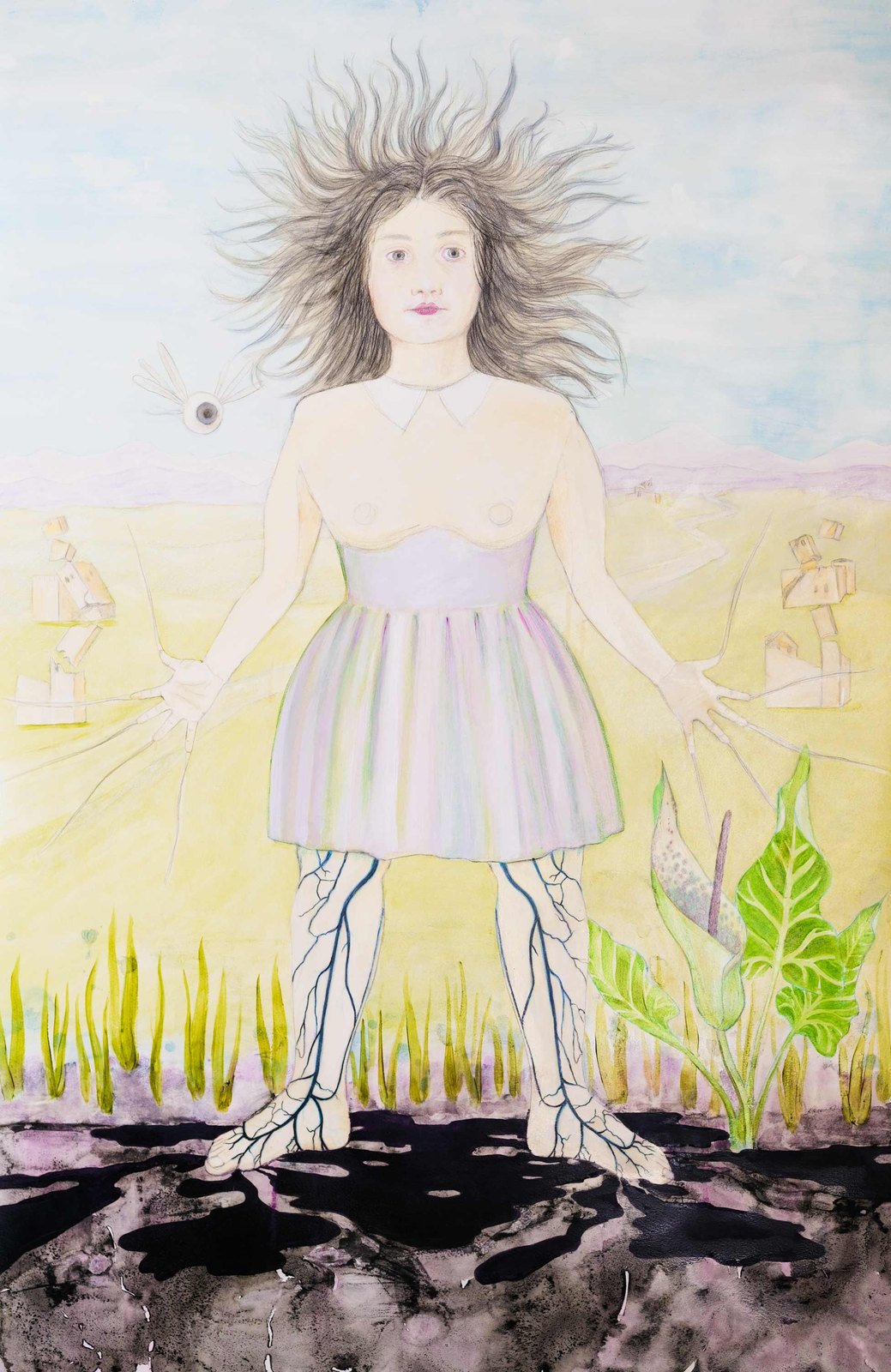
The starting point of this conversation is her new Struwwelpeter series, which can be seen starting October 3rd at the Lovelab Dreamspace in Berlin. In her work, the figure becomes the image of an unhappy consciousness: heaviness, fear, exhaustion, self-doubt, the feeling of being stuck in one's own life. The black water that, as the Turkish idiom goes, flows into one's legs becomes a metaphor for this — for a paralysis that begins within one's own body.
It is a paralysis that also speaks from her older images. Cassandra, who knows everything in advance and whom no one believes, wears severed hands on her head. A mermaid from a Berlin flea market has two wires instead of arms. A self-portrait is titled »Powerlessness.« It is repeatedly the same figure: a woman who sees and knows—and yet cannot act. Behind this lies the history of suppressed female voices: from the female draftsmen of the 18th century, to whom only botanical illustration was open as a medium of expression, to Marilyn Monroe, whose intelligence was only recognized after her death.
From here, it is not a long way to the bigger questions. Anyone who can describe so precisely what it feels like to be stuck in one's own consciousness will eventually ask what it feels like to have one that is not alienated. How does a lizard perceive the world? A cat? An intermediate being: a satyr, a nymph?
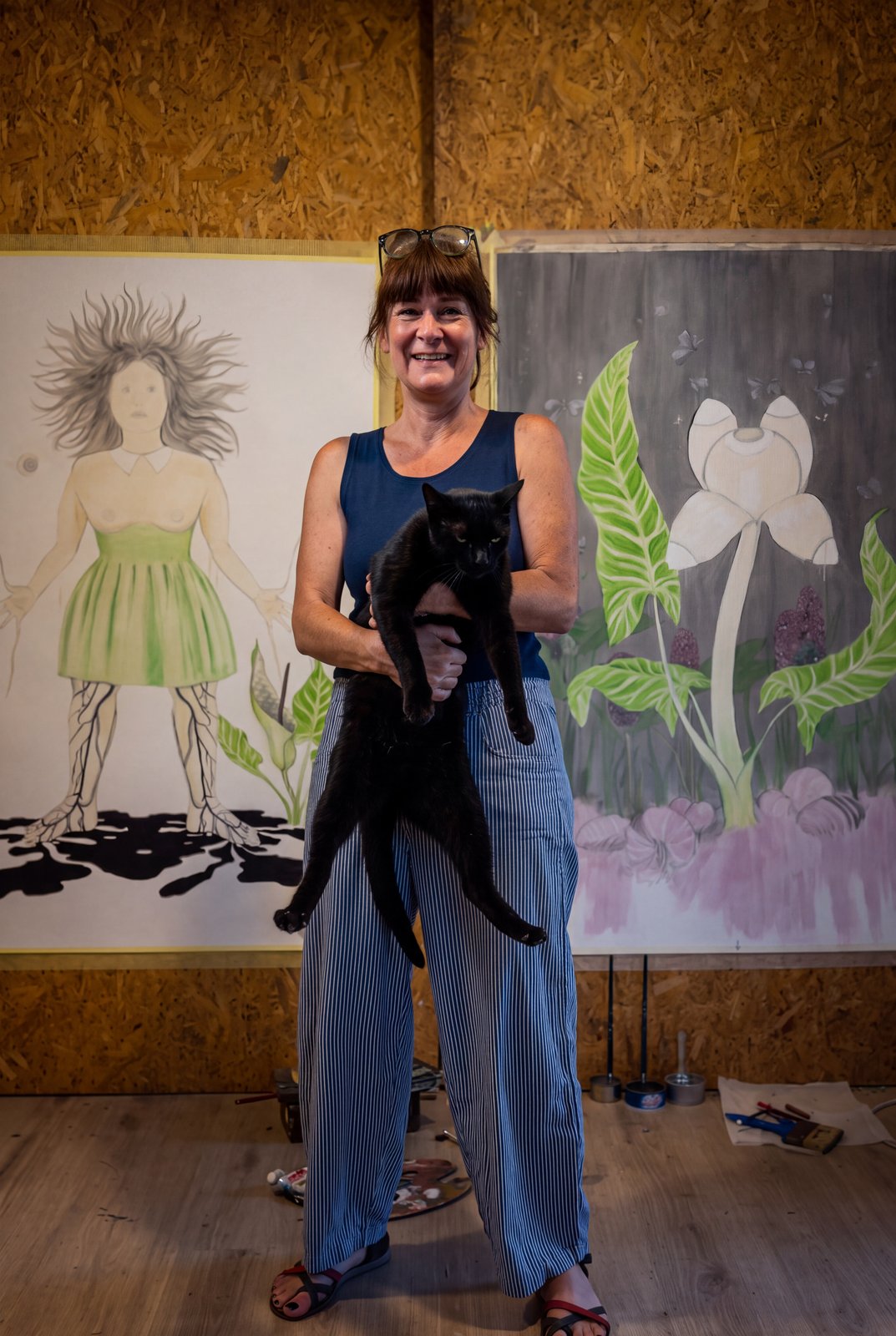
Tim Ra visited Banu Birecikligil in her studio in Bodrum.
The Black Water
RA Your new series has to do with Struwwelpeter, unmistakably through the long fingernails.
BANU Struwwelpeter never washed himself, never wanted to have his fingernails cut, and became scruffier and scruffier. He rebelled and did his own thing.
RA In Germany, Struwwelpeter is considered a manifesto of black pedagogy, as Katharina Rutschky and Alice Miller called it. It stands for a form of upbringing that operates through humiliation. For black pedagogy, it is the counter-image. Struwwelpeter is exactly how a child should never become. A deterrent example.
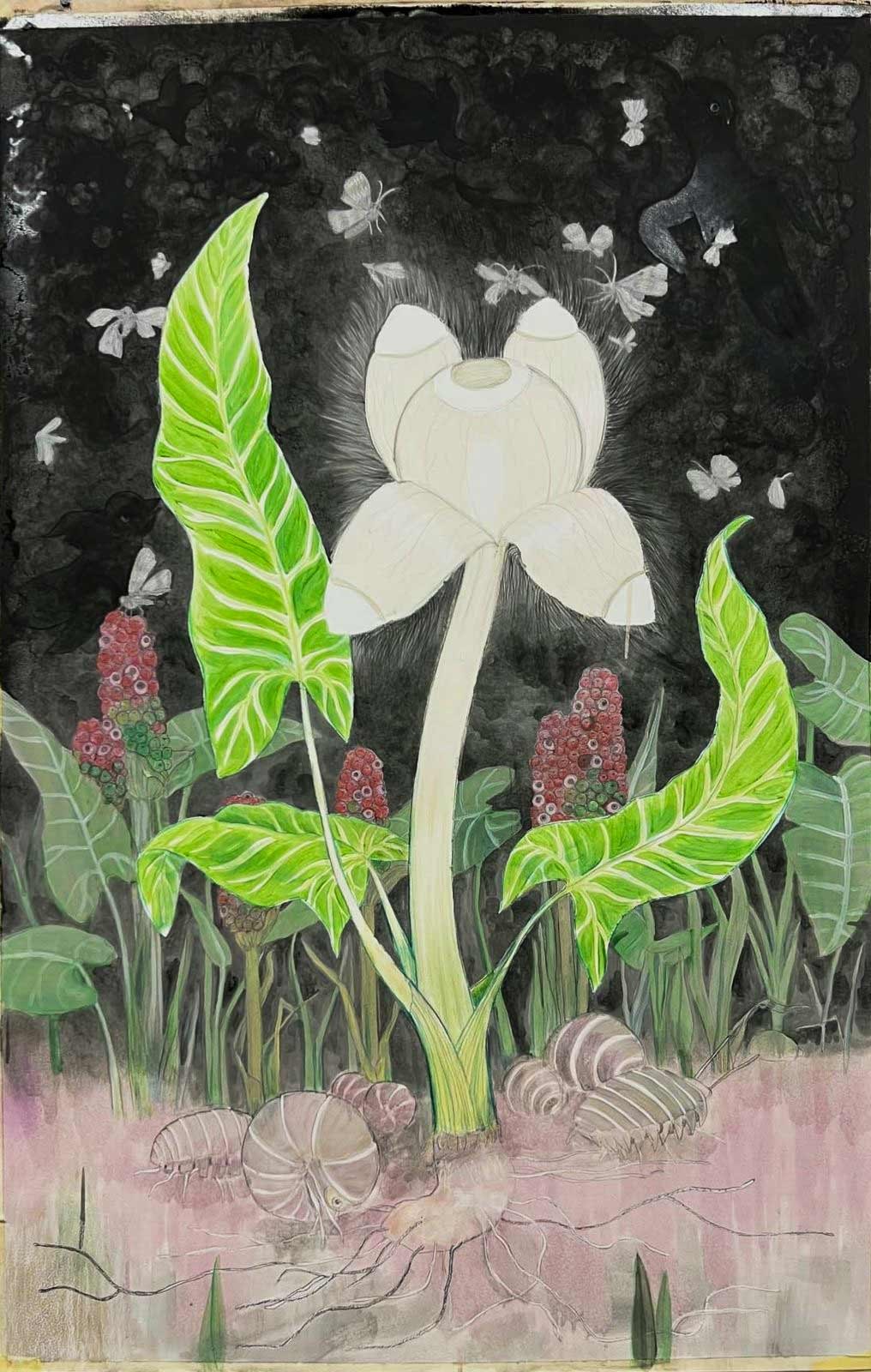
BANU I had him on my mind for a while. Not from the pedagogical side of things. I had this feeling of decay in my own body or my own soul. I was going through a difficult phase where I felt pretty black. Very heavy, leaden. There was a lot of stress, and I had thyroid issues. I couldn't sleep or would wake up in the middle of the night in a panic. And all this melancholy weighing down on me. There's a Turkish metaphor for that: the black water is flowing into your legs. I felt like my blood was like a black fluid, something heavy-flowing. I felt so heavy, and it was pulling me down. And hopeless — I didn't know the way forward, I didn't know the way back. It gave me this feeling of being stuck.
RA Was that a specific time?
BANU That was after the Covid period. Since last year, since the separation from my partner, I've been feeling much better. You have phases like that in life, and as long as I'm in that phase, images form within me. Ideas that crystallize into a symbol over time and then become a part of my painting.
RA What kind of plant is that on the left and right of the new series?
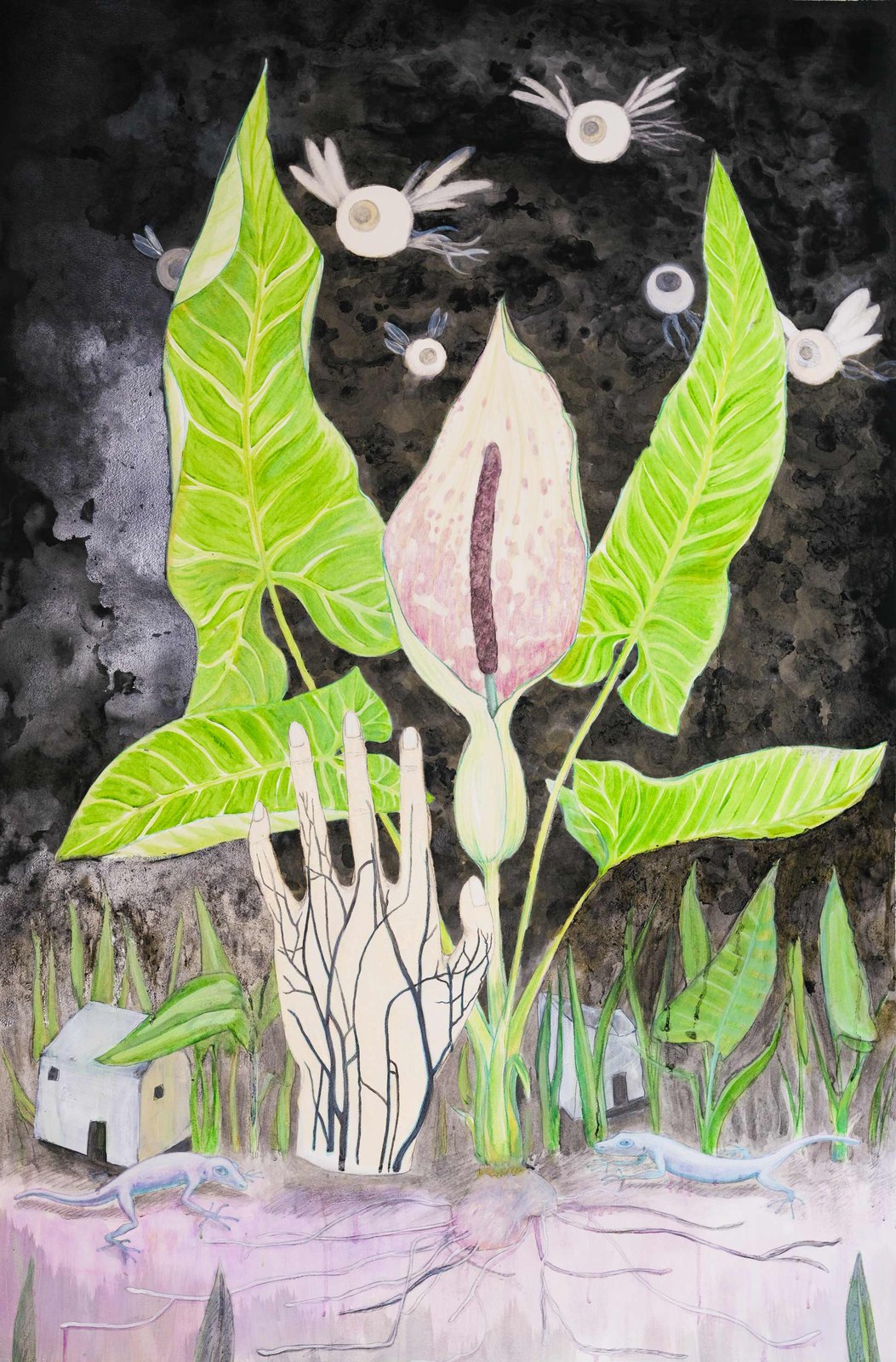
BANU One that exists around here. It smells terribly of decay, it symbolizes death, and it is poisonous. The arum, Arum dioscoridis.
RA And these black veins are the heaviness you spoke of.
BANU Exactly, that was the idea. Esotericism says that the soul resides in the blood, moves through the body, and gathers in the heart. And this melancholy really felt as if the red or blue blood had turned black and heavy like lead. That also reminded me of Pitch-Marie. This black, heavy blood, the liquid that flows down like pitch and collects in a pond.
RA A few weeks before I broke up with my partner at the time, we went on a trip. In the night, I dreamed about poisoning myself, about a black liquid running through my veins. That is precisely the poison I see in your Struwwelpeter pictures.
BANU That's crazy.
»I find language too direct«
RA Your pictures always have something of dreamscapes. With numerous symbolic-looking animals and people. You can tell immediately: This is an inner world that one is allowed to view from the outside.
BANU I often paint figures in landscapes, actually the landscape of the soul. For me, the forest has always been a symbolic image, also in the context of fairy tales. I have always been concerned with the inner world and with developing a language to explain it. My language consists of images because I find the written, the spoken, too direct. I find it difficult to pin something down so precisely because I often feel that through this definition everything loses its meaning.
RA Language often makes things unambiguous that actually want to be ambiguous. There is a way of speaking that pins things down: This is up, that is down, this drawer, that drawer. And then you are in the confinement where you can no longer be creative because you are constantly wondering which drawer you are currently in.
BANU If I were good at expressing myself with words, I might try poetry. There is something open and ambiguous about poetry. Whenever I try to explain something, I become didactic, and that constricts me myself. Images, on the other hand, come in very different forms: in dreams, in visions, in symbols and metaphors. It is a kind of puzzle where at the beginning I am still in the fog and I grab something somewhere to hold onto. Sometimes I don't even know what attracted me. And afterwards I notice that around this one symbol I can see a lot of myself — and of the collective unconscious, without me having tried to express anything.
RA That sounds like a research paper.
BANU Over time, a mythology of its own takes shape. You don't have to use symbols the way they were defined in the collective subconscious. In every culture, in every single person, unique imagery grows, shaped by the associations tied to one's own history. I had the good fortune—which I perhaps didn't perceive as such during my childhood—of growing up between cultures. To be able to bring together a synthesis without having to attach myself to a specific culture. That gives you freedom and a rich pool to work with and combine with your own symbolism.
On paper
RA What stage is the Struwwelpeter picture in? Is it a sketch, or already close to what is intended to be created?
BANU I usually work on canvas, and oil is a completely different way of working. You paint, you paint over, you take something away, you add something. For Struwwelpeter, I wanted to work on paper, and there you have to factor in the transparency, you can't paint over things as easily. Everything becomes more graphic, more deliberate, a bit illustrative.
RA A new approach.
BANU I was thinking about the female illustrators of the 17th, 18th, and 19th centuries. Women who were gifted in painting and science didn't have many genres in which they could express themselves. Many of them created insect and botanical pictures, scientifically accurate paintings, drawings, prints. That was an area where they could fit into society and do something creative. And there are very many who created magnificent works. I wanted to immerse myself in that — to approach the plant through drawing and in a somewhat scientific way. Which I don't normally do; I prefer things flat and naive.
My father was a doctor and surgeon. I still have all his surgical books and illustrated volumes, and I made these drawings from them. The plant here on the right has an eyeball. That is not a flower, that is a dissected eye, a medical drawing. I often used the eye as an eye with wings like a seraphim angel or as a lizard with an eye-head. For me, it is the symbol of higher consciousness.
The background is still to come. And I think I'll add some insects and lizards as well. But when I look at classic illustrative lizards, it feels too imitative to me. Maybe they'll be insects with faces or lizards with eye-heads, which I've used before. I'll be incorporating my own mythological creatures into it.
RA It is a triptych.
BANU Yes, but each of them should be able to stand on its own. I use small figures, small stories that bring this out of that academic way and back into my world. I try to be careful because everything that once gets onto paper doesn't go away anymore. But I have also found a peace in it, working slowly. With oil on canvas, it's more of a battlefield for me—with myself and the medium. There I think in layers and am never satisfied with the first. Nor with the second, sometimes not with the third.
The clairvoyant whom no one believes
RA Are there any symbols that have accompanied you over the years?
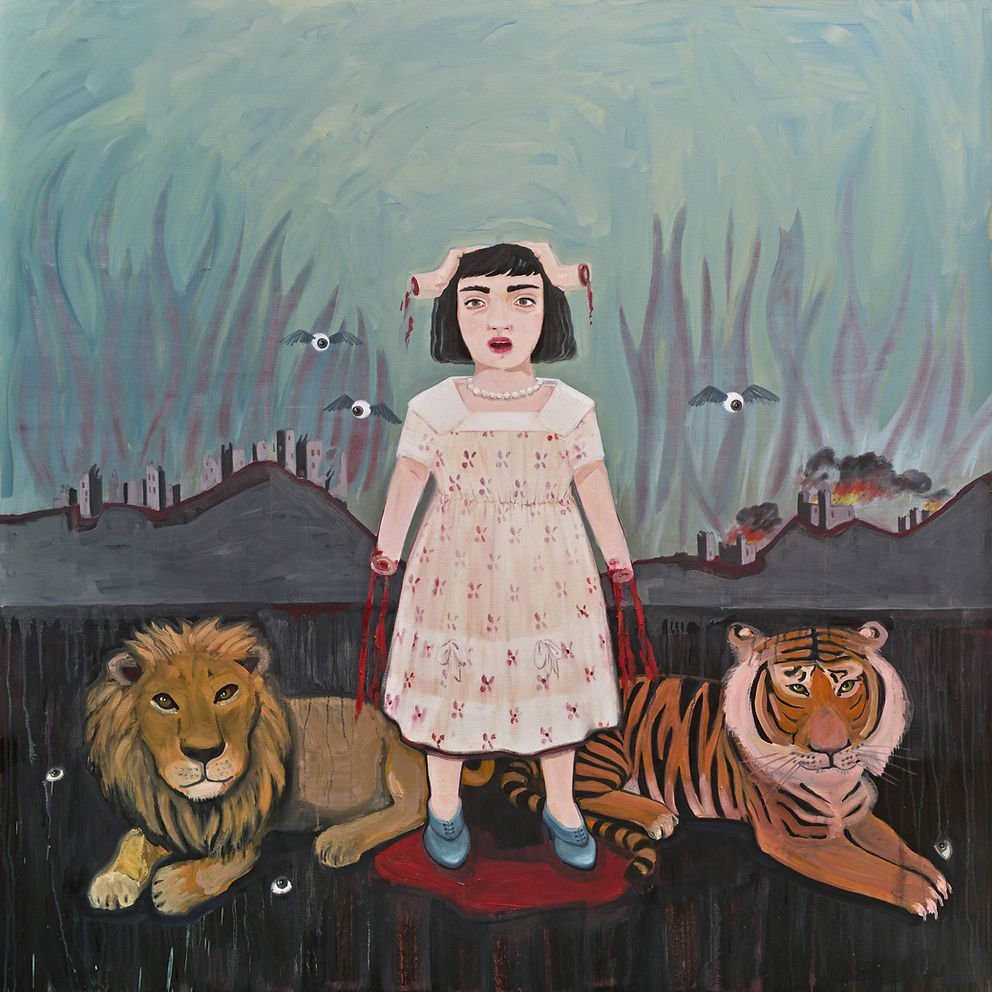
BANU I don't like committing to specific figures. I started quite naively to find my own images, and only in retrospect did I see that they express the collective subconscious in my own way. But there are certainly some themes. In my antepenultimate exhibition, for example, Cassandra, the clairvoyant whom no one believes.
RA I feel that way sometimes too.
BANU Back then, I felt the same way. It's nice how individual things come together — Christa Wolf's book Kassandra, which I read ages ago, came back to mind, and I thought: Back then, I didn't really understand that at all. This curse of clairvoyance, that simply no one believes you. You see the chaos, you want to share your knowledge. That doesn't mean you know everything better, but this state of ignorance all around...
RA What was going on back then? Why did you feel faint?
BANU I had the feeling of complete helplessness, the feeling of not being able to do anything. In the picture, cities are in flames. Above them, the eyes of high consciousness, as the seraphim angels are depicted. And the strength, the tiger and the lion. But also the severed hands.
RA Upside down. Wild. That's not part of the traditional symbolism, but your own imagination.
BANU My own, exactly. But I was referring to Cassandra. I didn't think of it directly at the time, but this burning city could also be Troy, which is conquered despite her warnings, and everyone dies. Back then, I couldn't get my naive and well-meaning warnings across to a man, and as a result, what I wanted to build with him in my life crumbled away.
»That's the patriarchy«
RA We were talking about you visualizing inner landscapes.
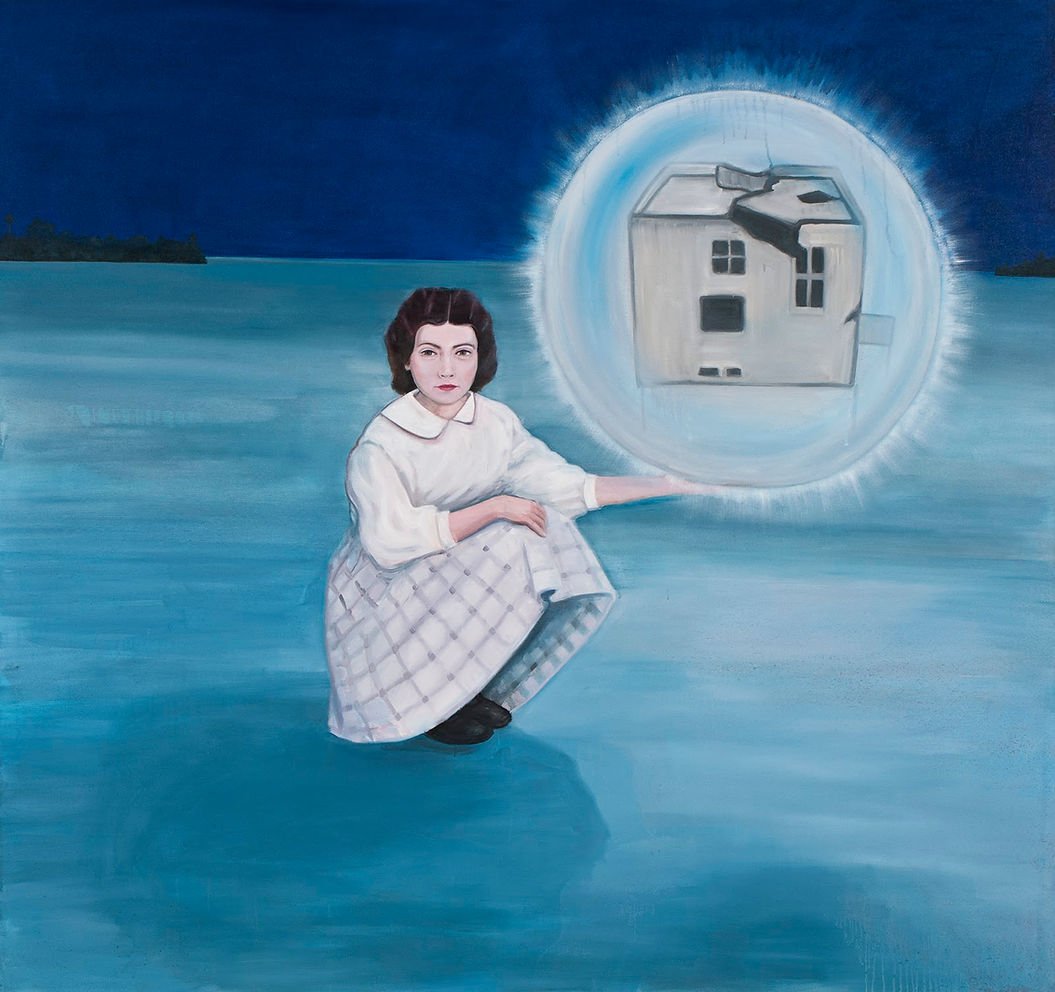
BANU I let the portrait create itself. My template here was a childhood picture of Marilyn Monroe, a black-and-white photo where she is squatting in front of her childhood home.
RA That explains the conservative, girls'-boarding-school-style clothing. The forties, probably.
BANU From that time. You don't choose a reference just for the body's posture. This house, hanging in a glowing crystal globe, reduced to a broken cube — a shattered childhood embodied in a magic orb. But it's not a portrait of her; it's an interior image. And this barren landscape around her represents the feeling of isolation.
RA Only in recent years has it come to prominence in the public debate how highly intelligent Marilyn Monroe was. During her lifetime that was not part of her image, she was the somewhat dim-witted blonde sex symbol.
BANU Back then, I read a biography about her. I found it very tragic how much she was reduced to this idol and sex symbol figure. She wanted to outgrow that, truly show herself as an actress, and earn respect, but she simply couldn't break out of that constraint.
RA This reduction had been socially normalized. For many female idols of this era, this was the primary focus, and intelligence was more of a hindrance. That also makes me think of Hedy Lamarr.
BANU Also a female genius, a scientist actually, and still very unknown. It's incredible how, over time, I've realized just how many suppressed female voices there were. When I was sixteen or seventeen, our English teacher gave me a book, a feminist one that portrays the history of women. It was shocking, as a young woman, to see what was actually going on in our history. That societal role assigned to you is pretty internalized. So internalized that you have trouble thinking your way out of it yourself. It takes time to emancipate yourself internally, also as an artist. During my studies, we were taught: Most artists are simply men.
RA Which was also true — only the cause is left unsaid. That they were suppressed voices, that it was undesirable for women to have influence and a voice of their own. That is precisely what is also in your Cassandra motif: the woman who foresees everything, and no one listens to her. That is the patriarchy.
BANU And this devaluation of women as crazy, as hysterical. It's a tragedy what many women had to go through. That makes you angry.
A whale in Istanbul
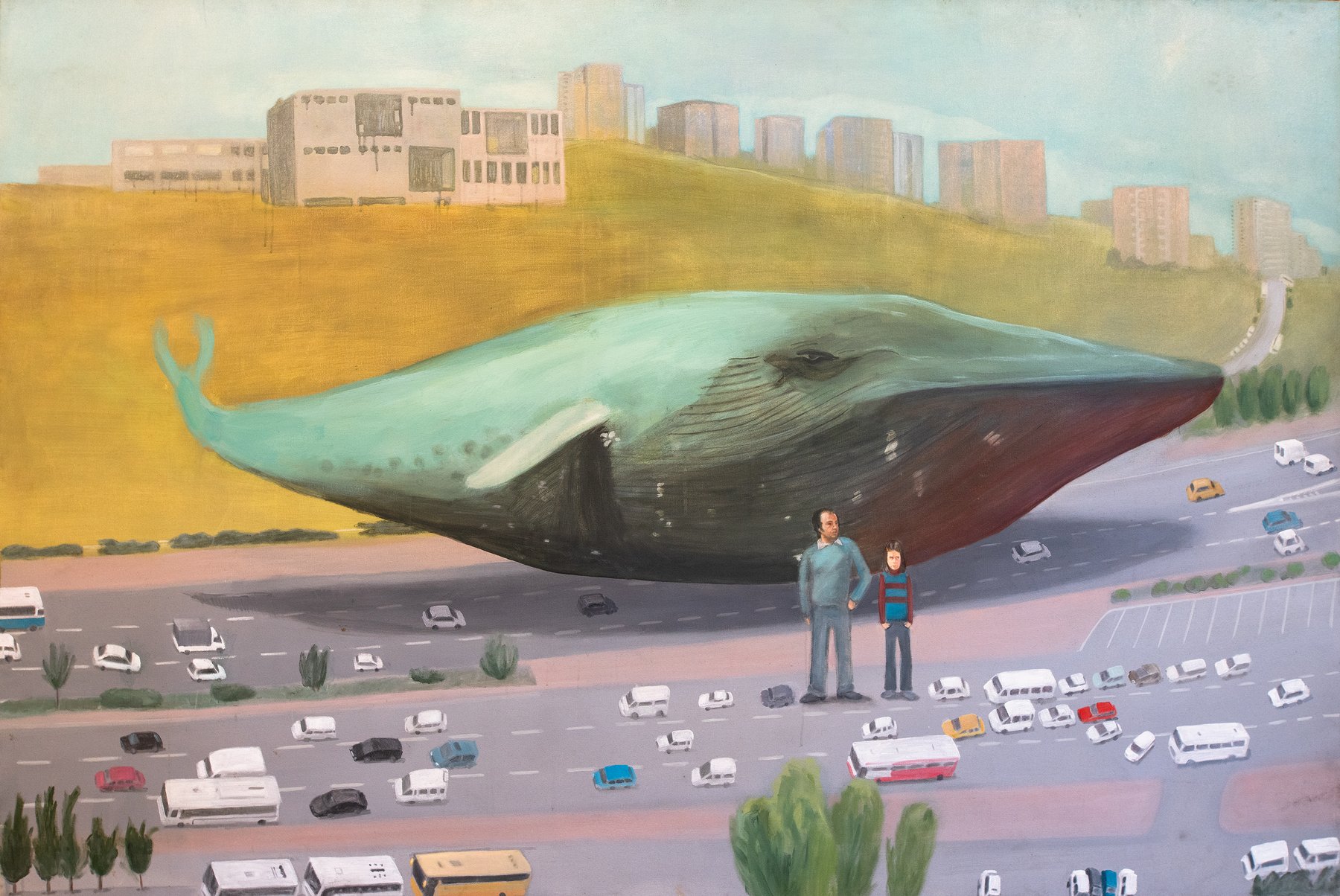
BANU That is me and my dad, at the Natural History Museum in London. We have so many family photos from back then. The picture was created later — it is one of the first ones I painted when I moved back from Berlin to Istanbul. An urban landscape, mixed with a landscape of memories and feelings of belonging.
RA There are no London buses.
BANU No, Istanbuliotes. And that is a Turkish highway. Only the whale is from the Natural History Museum. Back then, I was walking around the outskirts of Istanbul photographing the city, which was growing larger and larger twenty years ago. You get used to it over time — no, you don't get used to it, but at some point...
RA It is no longer perceived.
BANU One no longer wants to perceive it. Back then I still had the perspective from the outside. Ten years in Berlin — and then the question of what one's hometown actually is, what it has become, and no longer this old image that I had from my youth. This displacement of the whale in the middle of the city, this being-placed-into-it, that expresses something.
RA And what does the whale represent?
BANU Perhaps primal knowledge. The whale gives me the feeling of arcane primal knowledge that is not very accessible to us nowadays. Similar to the crocodile in some of my pictures. — Help me with a word: displacement.
RA Forlornness is an aspect of it. Being in the wrong place. In Germany after the war, the camps were called DP camps, for displaced persons.
BANU Displaced is the word I would choose for this feeling. In German, there are only weird words like »Heimatvertriebene«.
RA Uprooting is another aspect of this.
BANU Yes, or that fragile quality. That feeling of a character in a place where they don't actually belong.
RA You look a bit angry in the picture, with your hands in your pants.
BANU Back then I had a red-and-blue sweater. It said on it: my name is nobody. I didn't paint that into the picture. And I think that's just how I felt. And yet I loved this natural history museum. As I recall, I felt very comfortable there. But I actually had this skeptical facial expression. Maybe more like: What are we going to do with this whale here in this city now? Why did we suddenly end up here? Just beamed in like that.
RA Where did you live in Germany?
BANU Near Kassel, a small town, Eschwege. That is where I grew up. In another picture, we are sitting there in the garden—it could be that I was a bit mad at my father. That's why I didn't paint his face.
RA Why angry?
BANU I am no longer angry at him. But after moving to Turkey when I was twelve, he wasn't allowed to work for two or three years because his education wasn't recognized. That made him totally sick. We had financial difficulties. Anyway, it was a difficult time after the 1980 coup. My father became increasingly closed off, aggressive, and sad, and that feeling cast a shadow over my puberty. The eighties were pretty depressing for our family.
RA Why did he want to go back to Turkey of all times?
BANU It was simply homesickness; they had already spent ten years in Germany. In hindsight — maybe we would have been happier if we had stayed. But you never really know. I'm actually very glad to have grown up as a teenager in Istanbul. It wasn't easy to reintegrate culturally, but it was an enrichment.
The disarmed mermaid
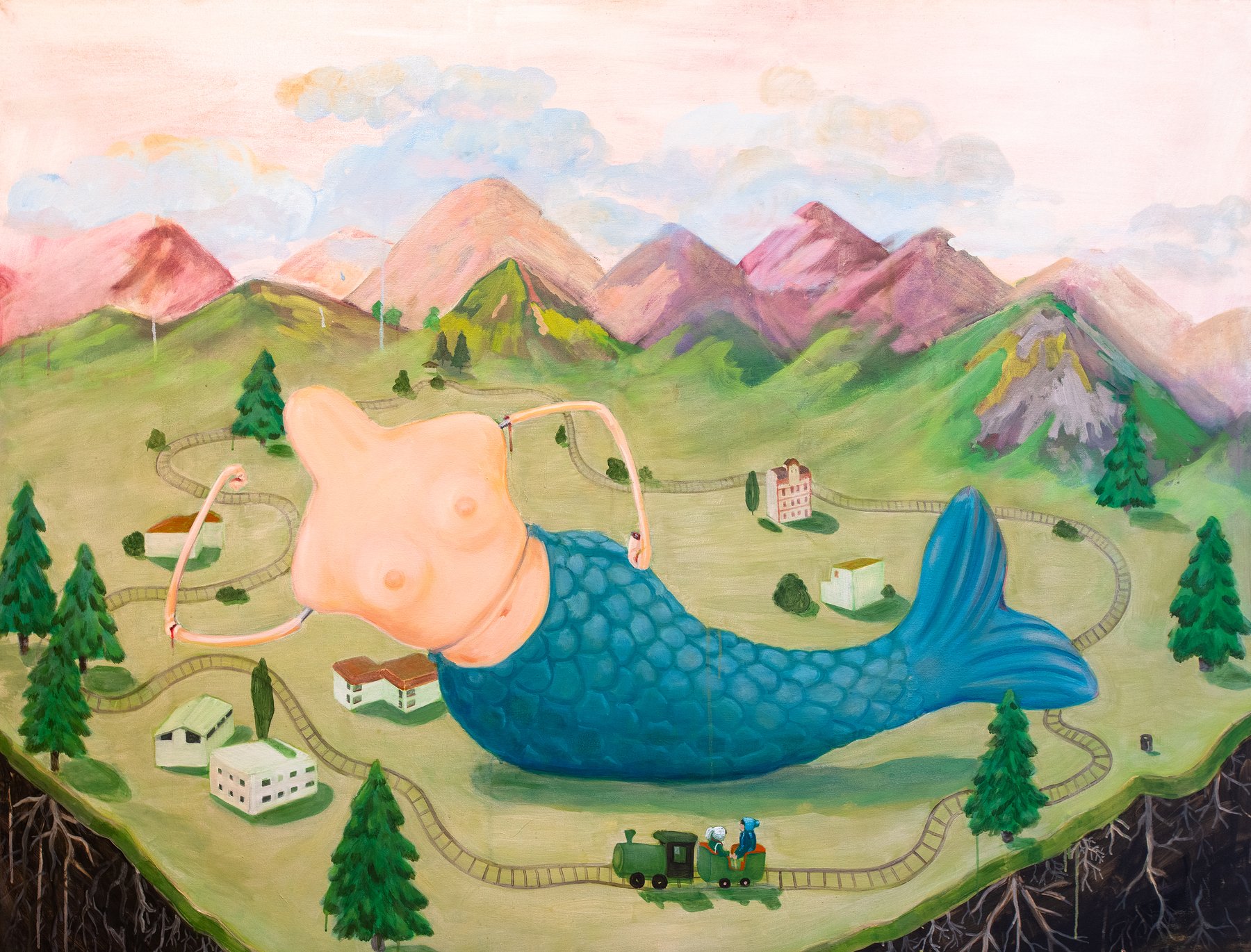
BANU »Lunaparc« is one of my favorite pictures. This mermaid with wire arms, without a head—a little figure that I found at a flea market in Berlin, presumably from the GDR. I don't even know why she didn't have real arms, it was probably for hanging her up. But very grotesque and very surreal. And again this Displaced-His. Both pictures were taken at the same time.
RA And yet another sea creature.
BANU The mermaid has her own mythology, too. Through this figure, I had the idea back then to make armless sculptures — a few years later. The feeling of helplessness. And this blood dripping down her joints…
RA The mermaid is considered a feminist symbol because she is a strong figure. Also as a siren who lures men to their deaths, she is symbolic of women's power over men. With you, it is the other way around. She is disempowered.
BANU This is precisely that dilemma: the feeling of powerlessness and being disempowered, of not being able to act, of feeling numb. That, too, is a kind of Cassandra.
RA On another level. In this case, it's the arms that can't do anything. The head is missing too.
BANU Later I painted another picture, a little mermaid on a rocky cliff, stormy sea, without a head. Somehow quirky, but I like such details. After all, I didn't paint oceans of blood, just these small symbolic fracture points at the joints with tiny drops of blood.
Around it runs a railway line in a circle. In the back of the landscape stands the house where I and my sister lived with our parents in Eschwege — and in the front are buildings from an urban landscape, inspired by the periphery of Istanbul. My sister and I are both riding in one of those small children's playground train cars. And this sliced-open earth with its roots, as if it were a piece of torn-out landscape.
RA As if the piece of landscape had been taken out and put somewhere else. Like model railways, those boards.
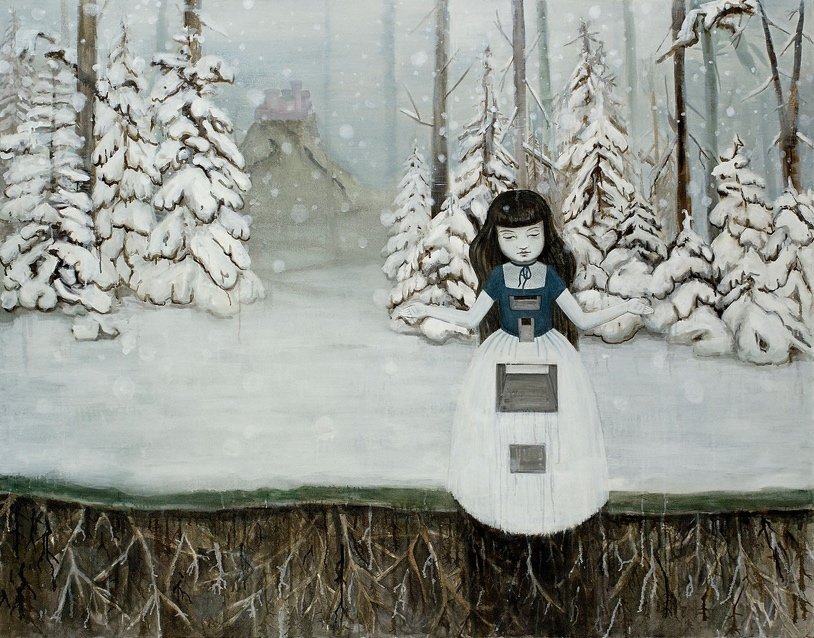
BANU Exactly, a model railway landscape, but one that has its roots. In another picture, called »The End of the World,« I have this kind of cut-out landscape in the foreground again, where you can see the roots and where a female figure is hanging in the air, possibly plunging down. This feeling of being cut off.
[later, while browsing the catalogs]
BANU And this here. I called this one »Powerlessness«.
RA And that is yourself.
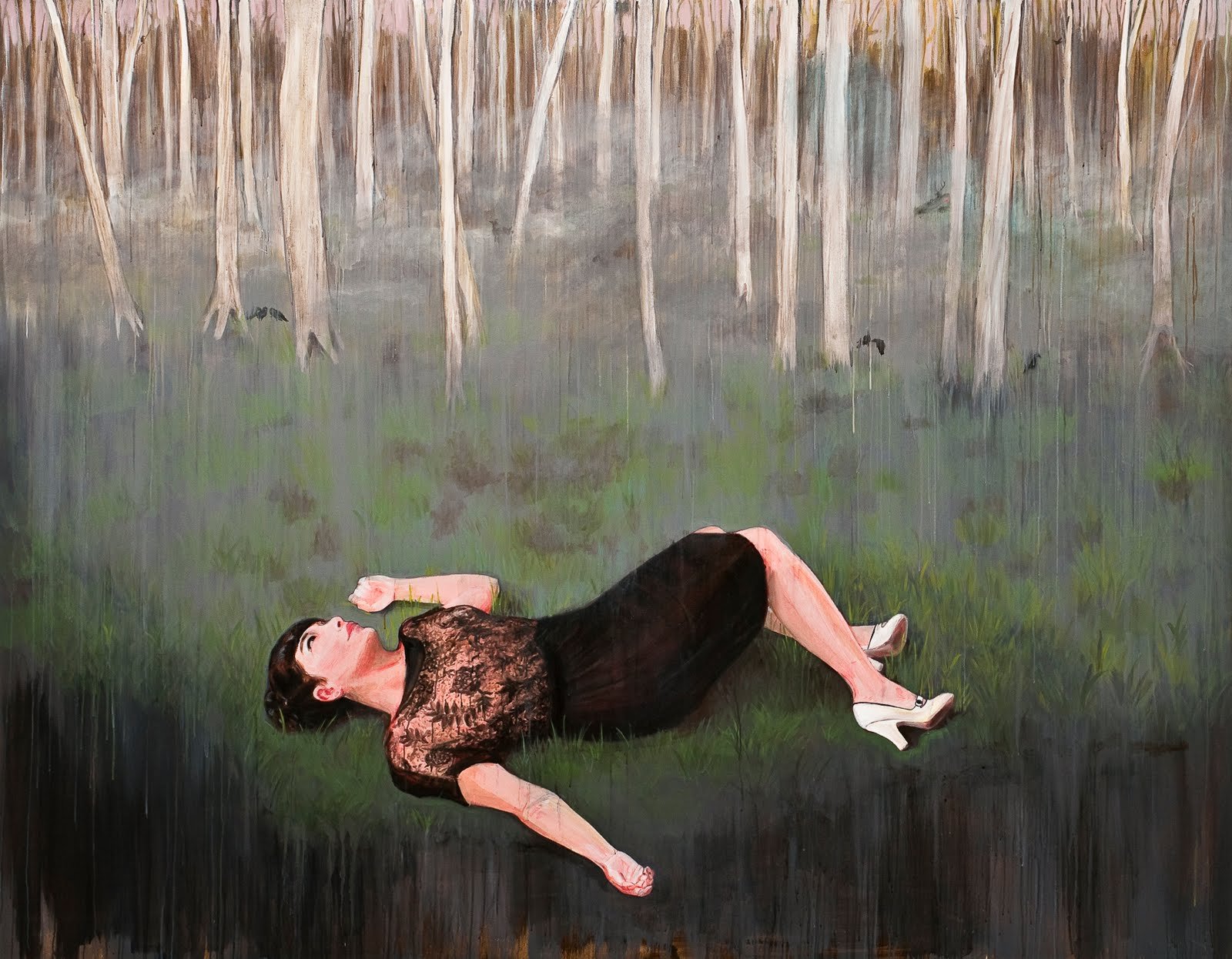
BANU Yes. It is one of the few pictures where I really painted myself. I had taken a photo series of myself with a self-timer.
RA There are some among your pictures that look like you.
BANU You look after me, but otherwise I don't exert myself.
The Dream of the Lizard
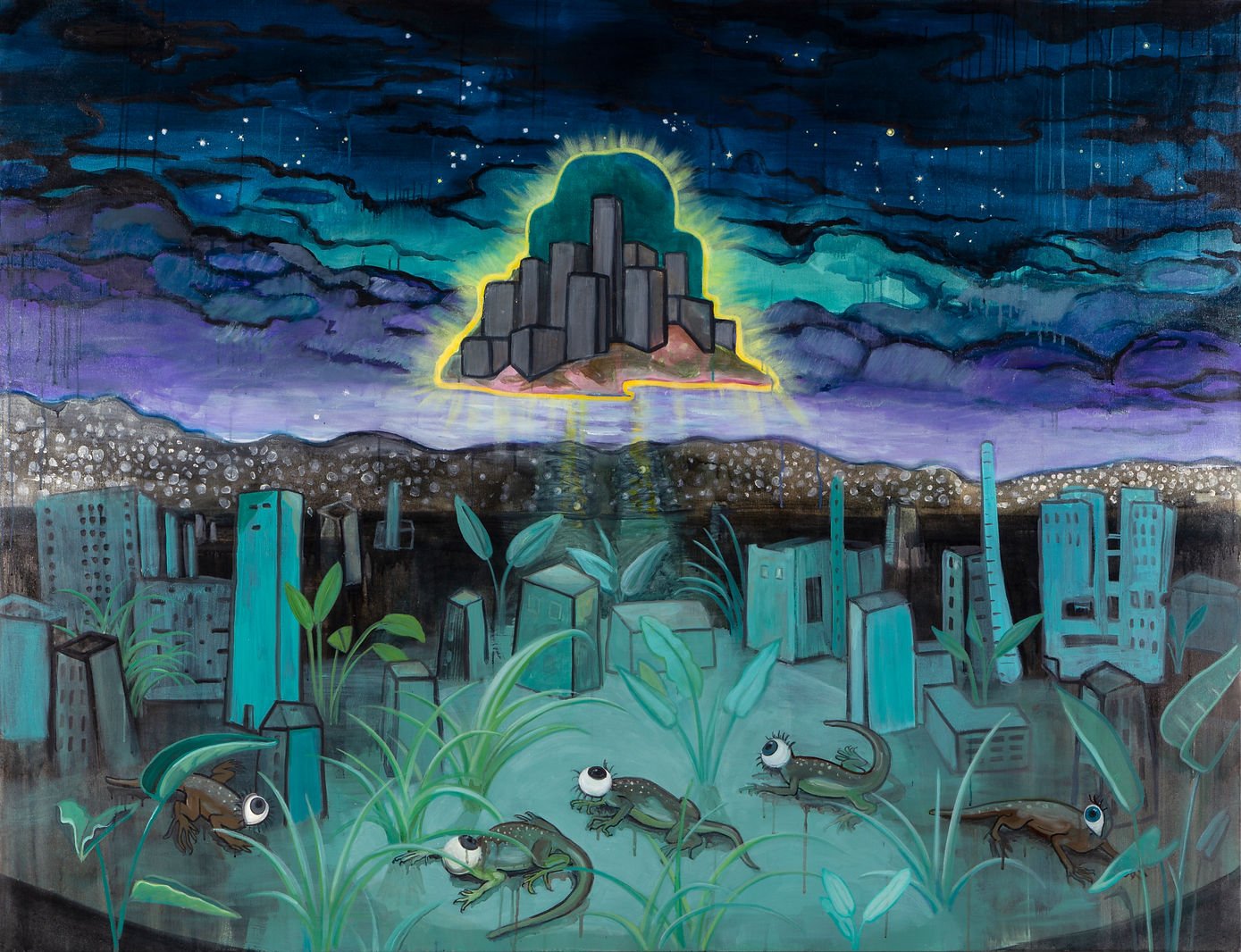
BANU »The Lizard's Dream« was created in 2020. I had started it before the Covid era, but it overlapped, and I finished painting it during that time. And it's really strange how the pandemic overlapped with the painting. Like a premonition. What you see here is a kind of dystopian city that comes floating by like a spaceship, suddenly appearing in the sky, and everyone runs away in a panic.
The picture is based on a dream. I am in the city, suddenly the earth shakes, and a whole fleet of spaceships comes flying from the horizon, and everyone is running around chaotically in all directions. I notice how, like in an earthquake, the shaking gets more and more violent and the earth gets hotter and hotter. And suddenly I see a terrarium with lizards being heated from below. And the lizards cannot escape and perish.
RA A nightmare.
BANU Yes. It felt pretty real. I experienced the dream very intensely. It's actually an image about extraterrestrial intelligence perhaps, no idea. There is definitely something there. And back then with Cassandra, I already had those angel eyes, which I used again here, with the lizards. The inner eye or higher consciousness.
RA It is only in recent years that it has become scientific consensus that other life forms have consciousness. That has taken centuries, which I find astonishing because it is so obvious. Descartes had this idea that animals are like machines. And then it took four hundred years for scientists to develop experiments that prove the opposite — and only through proof is it accepted. For me, it is self-evident: I only have to look a cat in the eyes.
BANU I cannot imagine this brutal narrow-mindedness — even back then, seeing and treating other people as non-humans.
RA Complete lack of empathy.
BANU Totally psychopathic. And I think that our society has very psychopathic traits. You can see that an animal has feelings, you can feel it.
RA It is an ideology of supremacy. If you think that way, you can do whatever you want with other living beings.
BANU Some people can only imagine what humans have invented. In Descartes‘ time, mechanisms were known; today, computers are known. That is why intelligence is compared to computers today. This is understandable, but it does not do justice to reality. The more we learn, the more complex the analogies become. Yet one must be aware that we can only think as far as this, and that in two hundred, five hundred years, we will think further. And recognize more and more mind. We will realize that we do not always have to exclude what we do not understand, just as we once classified animals as mindless, as emotionless, as devoid of consciousness.
RA And today even animals and rivers are getting rights.
BANU That's great.
The night walk
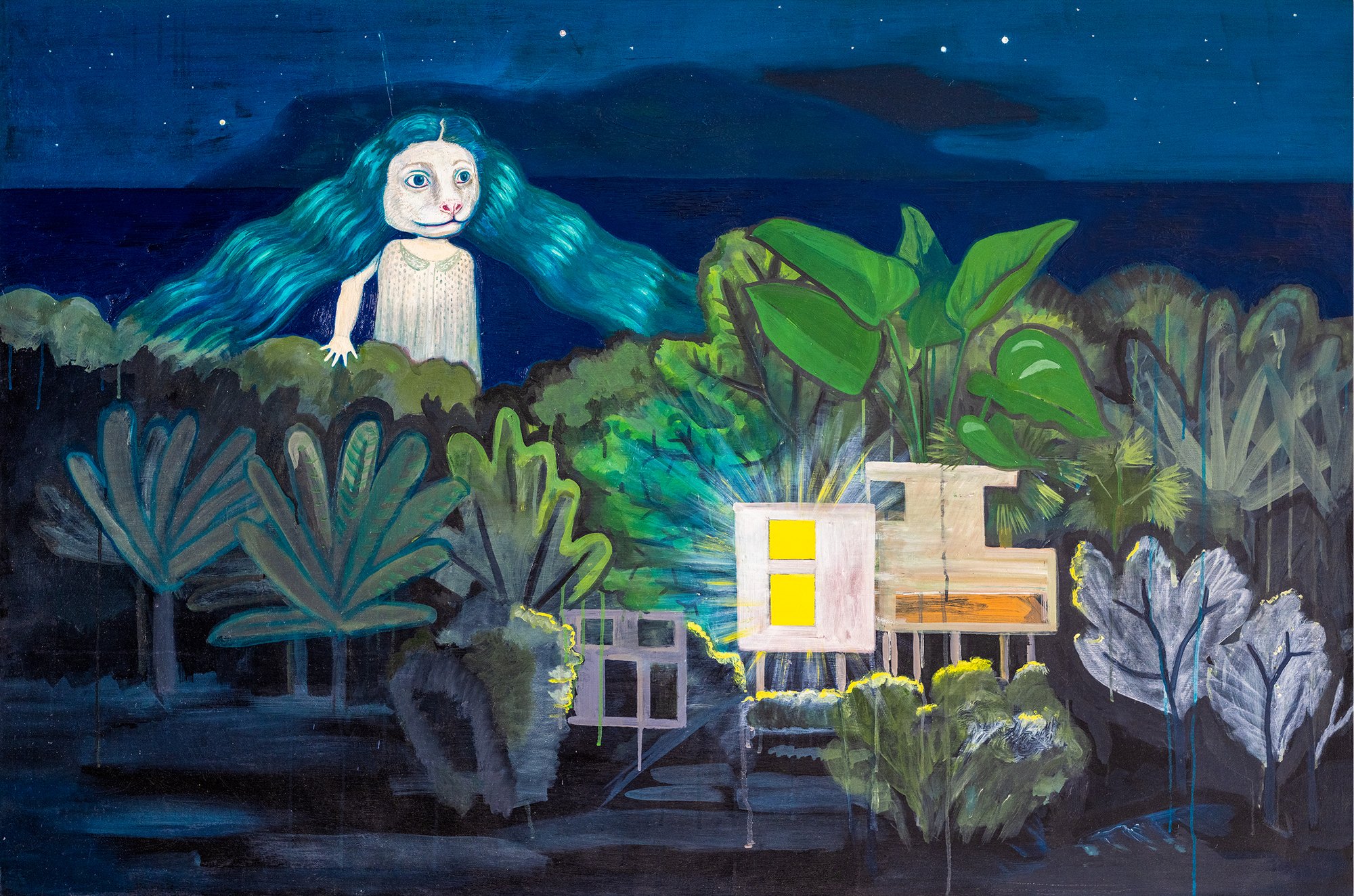
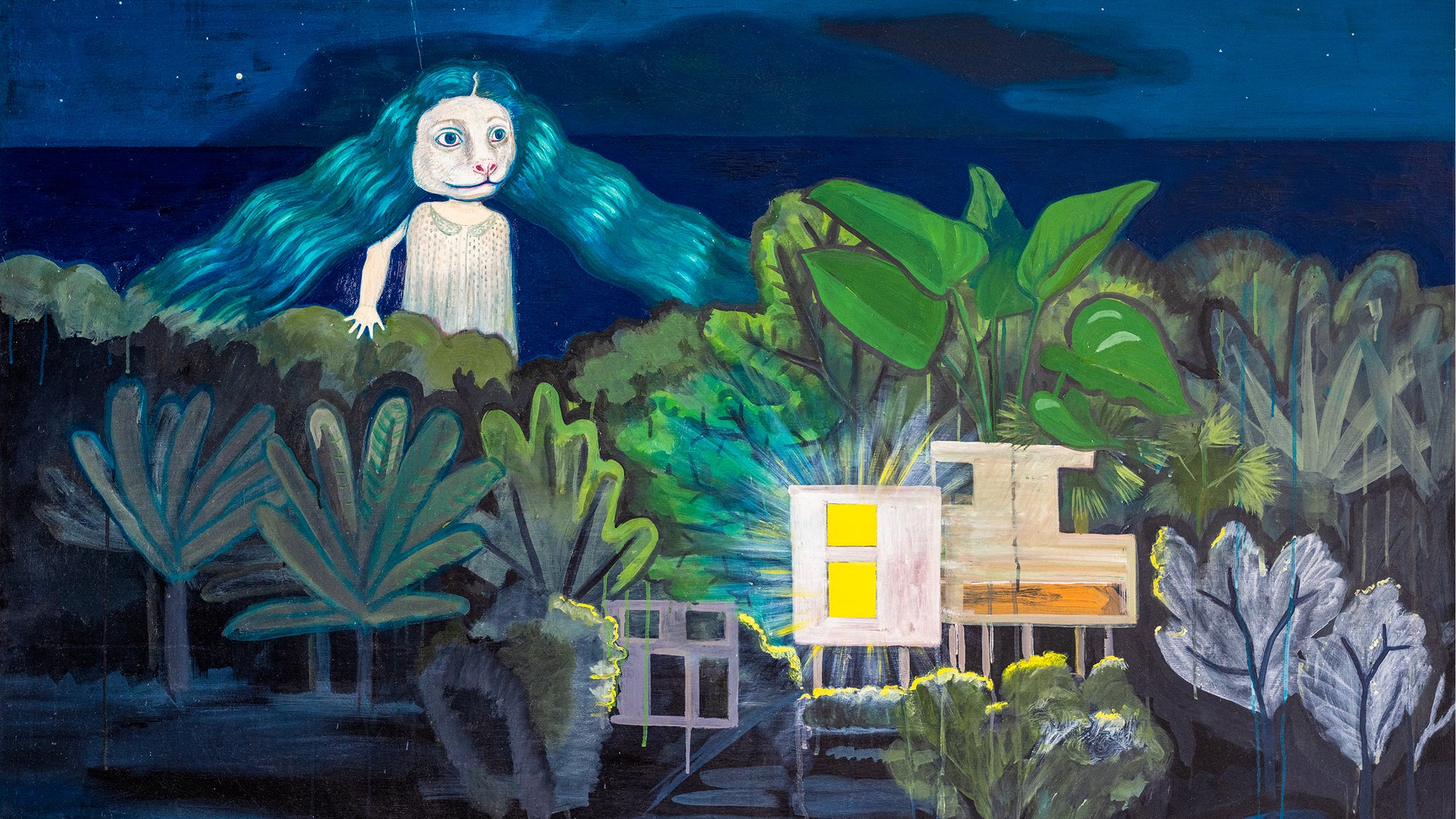
BANU This is a picture of a satyr on a night walk. That is also its title. And the house represents the innermost self.
RA In a very radiant sense.
BANU Yes, as radiating light. That is the attempt to explore the other consciousness. As you said earlier: When you look into a cat's eyes, you see a consciousness there. I wonder how animals perceive the world and how they feel and think. And this whole mythological world of intermediate creatures, between human and animal — that is, between this primordial consciousness and our alienated one, the way we live today, alienated from all these natural forces.
RA I think it is easy to put oneself in a cat's shoes. As someone who lives with cats, you know that better than I do. That one can feel along with them to understand how they perceive the world. I don't think we are completely excluded from that. I also see it in my little son, who runs around like a cat all the time. Not that it is exactly the same as what the cat feels — but consciousness can connect with one another. And in that connection, you learn from each other.
BANU But I do wonder what that would be like. What it feels like to be a nymph or a satyr. Or this wildness, to live in the wild. To carry this wilderness within oneself.
»The Nightly Walk« appears as a limited edition Lovelab Edition #4.
The exhibition featuring works by Banu Birecikligil will be at the Lovelab Dreamspace to see, Pappelallee 25, 10437 Berlin. If you don't want to miss the next dream: enter the dream.