
The late revenge of 1968
Springer, Poschardt, Peter Thiel and the farewell to the democratic post-war consensus
From the once nationally conservative Springer Verlag, it has become an actor of the international new right. Ulf Poschardt’s pamphlet against »shitty bourgeois« stands as an example of the cultural struggle against the long-time left-liberal dominated education and culture elite. At the same time, precisely those principles on which Springer once based its self-understanding are eroding: liberal democracy, social market economy, transatlantic ties, and a special responsibility towards Israel and the Jews. Springer’s late revenge against 68 is thus much more than just a cultural struggle: it marks the transition of part of the bourgeois establishment from defending liberal democracy to dismantling it.
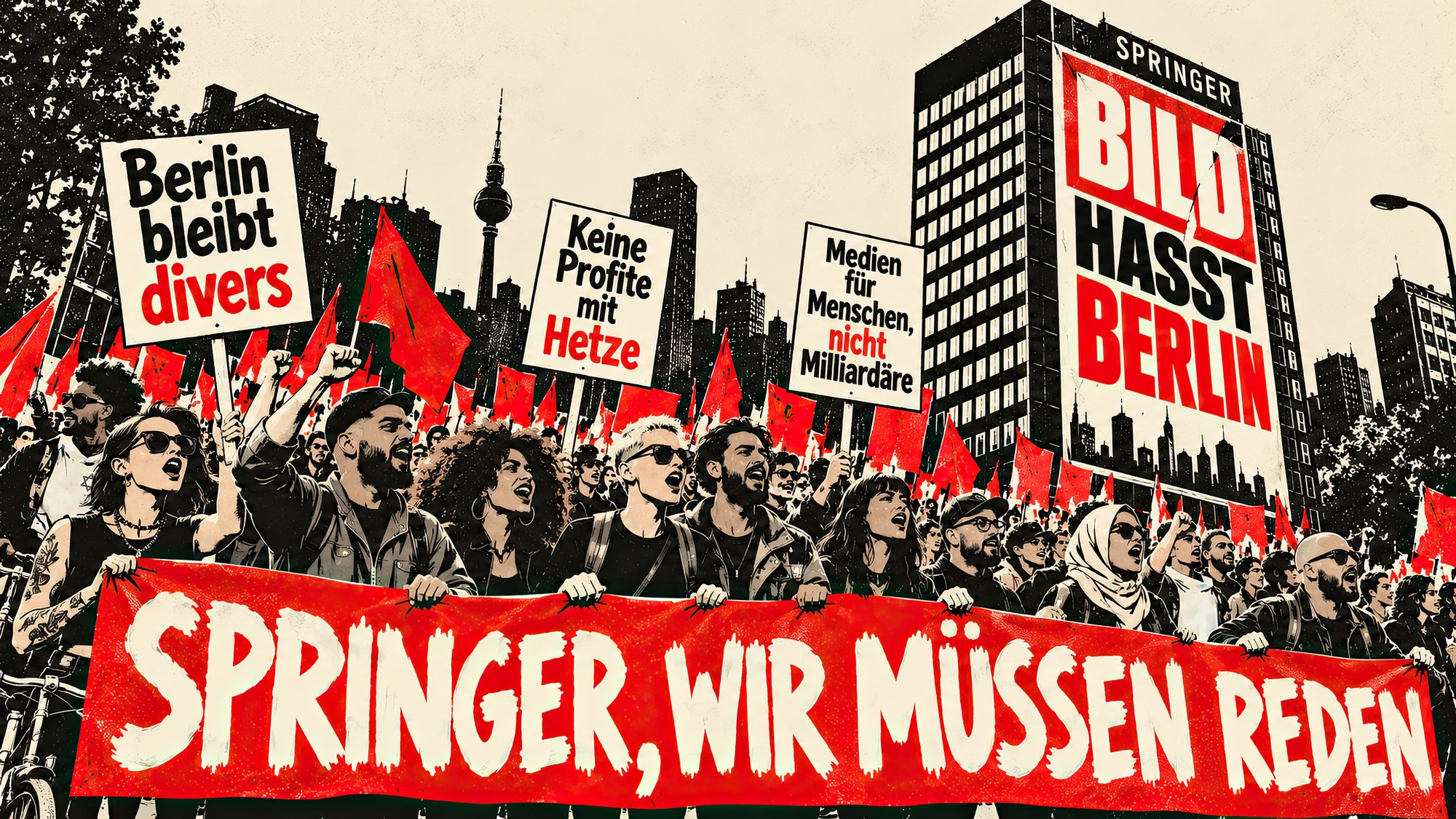
In 1967/68 Springer was not just an opponent of the student movement, but its founder’s enemy. »Enteignet Springer«, the blockades of the Bild newspaper after the assassination of Rudi Dutschke, the justified accusation that the paper had contributed to the climate for violence: the publisher became the epitome of the backward-looking attitude. The cultural hegemony moved to the left in parallel, in pop culture, art, the university and the feuilleton, and remained there for half a century. Springer remained powerful but uncool. In the high-rise building on today’s Rudi Dutschke Street, one has never forgotten this humiliation.
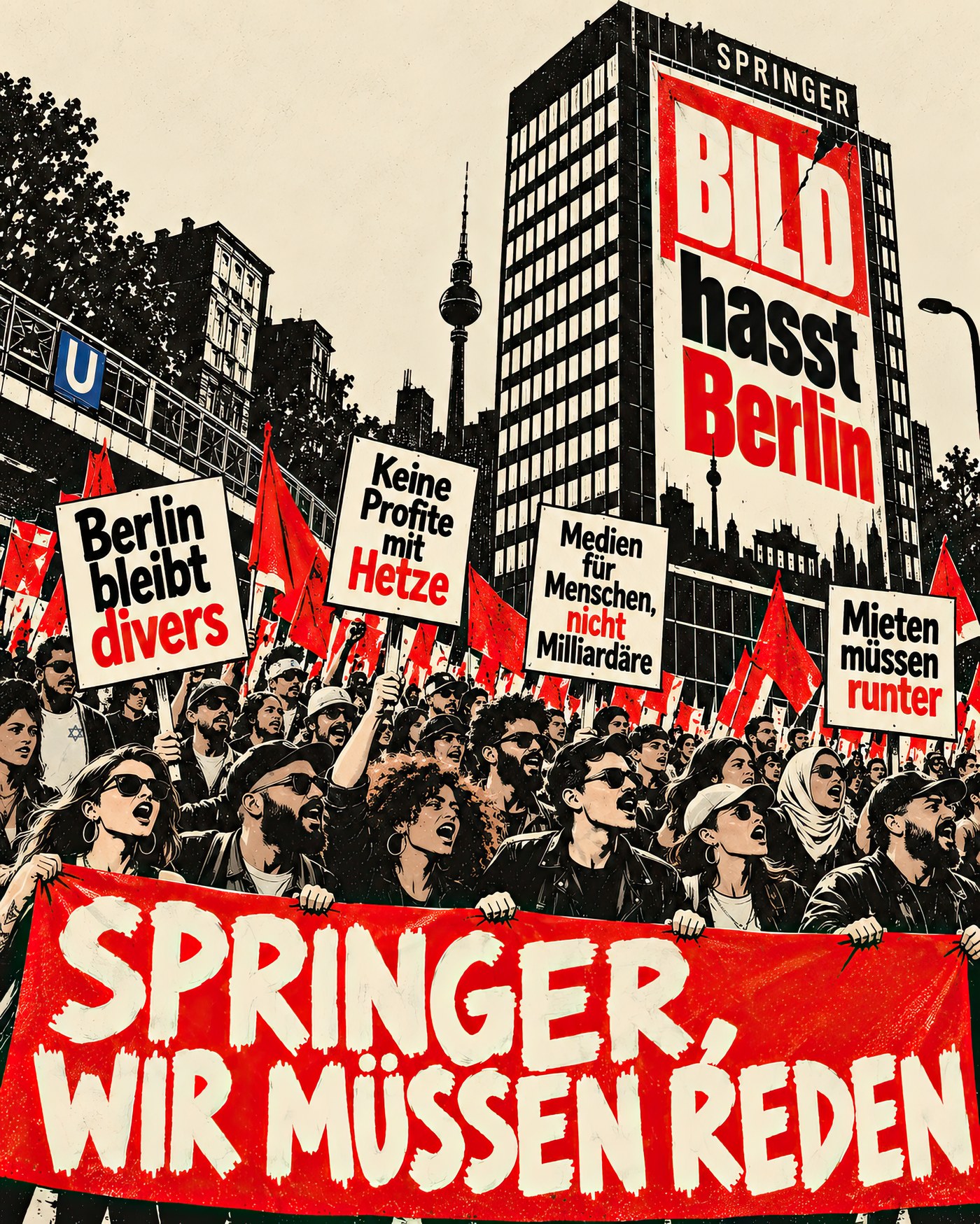
With the rise of MAGA and a worldwide right-wing populist movement, today offers the opportunity for revenge. Certainly, the new right is also about rolling back the social liberalizations of the 1960s and a economic policy of »Anything Goes«. But the moment of revenge is unmistakable: it is directed against the cultural elites, against their language, their morality, and their lifestyle. Poschardt’s »Shitbürgertum« exemplifies this. The term targets the green academic milieu, which in this reading defines the codes of respectability. What is attacked is not so much a politics as a social class and its cultural self-assurance. Revanchism, as it stands in the book.
Ulf Poschardt is the most informative figure in this respect. He began as a knowledgeable and nuanced author with well-researched books on DJ Culture and Coolness. Today, he opts for loud provocation, explaining the distinction between right-wing hate speech and a strategy of power by the Left. One could read this as a break; what is more interesting is the continuity. For Poschardt, Coolness was always more of a technique of differentiation than that »cool knowledge« that the Spex once located in progressive politics. It is directed against the mainstream, the conformist, the adapted. If the conformist is left-green in their worldview, they show the same gesture towards the right. The logic of the demarcation remains the same; only the opponent changes. The once politically progressive codified Coolness degenerates into arbitrariness, until the rocker costume itself becomes the last argument.
At the beginning of the millennium, Springer had already adapted to the changed cultural landscape. Under Döpfner and Kai Diekmann, the house was flashy and lifestyle-oriented, from »We Are Pope« to the music and youth formats in its portfolio. But that was more of a period of adjustment. By 2010, the other direction was evident: Bild was making noise against the »bankrupt Greeks«, and Springer intensified Thilo Sarrazin's racist theses in a publicistic manner to the fullest extent possible.
There is, however, one crucial difference from 1968. Axel Springer was nationally conservative, Christian and paternalistic, but not neoliberal. Bild spoke to the »little man«, not the libertarian entrepreneur. Market-oriented ideas existed long ago, in the Mont-Pèlerin Society as well as in Ordoliberalism, but they were embedded in the Western post-war consensus. They only became dominant gradually, starting with Thatcher and Reagan.
On September 24, 2026, Springer finally parted ways with the democratic post-war consensus and awarded the Axel Springer Award to Peter Thiel. In 2009, he had already written that he no longer believed in the compatibility of freedom and democracy. From this he developed, accompanied by wild conspiracy theories about the Antichrist, a libertarian vision whose goal is the final exit from the constraints of democratic politics, from Seasteading to private, autonomous communities led by CEO kings, as promoted by the ideologue Curtis Yarvin, whom Thiel has supported. At the same time, he is a co-founder of Palantir, the company that Springer praises in the award citation as being important for the »resilience of democracies.« This is the bizarre point: a publisher that relies on defending Western democracy honors a man whose political vision aims to eliminate it.
The old transatlantic allegiance was once a commitment to the West, to liberal democracy, the social market economy, and anti-communism. Today, it is practically a commitment to the Trump camp.
The same applies to a second pillar of the house. After the Shoah, Axel Springer wrote the reconciliation with the Jews into his publishing principles. This was also a counterpoint to right-wing press of the kind of Hugenberg, which in the Weimar Republic had prepared the ground for the NS-hatred, and it is one of the great achievements of the house.
Today, the former border wall has deteriorated. It is not meant to protect against the AfD with its long list of antisemitic incidents, but to defend the Israeli government, in which right-wing extremists like Itamar Ben-Gvir and Bezalel Smotrich hold key positions. Against their boss Benjamin Netanyahu, the International Criminal Court has issued an arrest warrant for alleged war crimes and crimes against humanity, including the starvation of the civilian population as a method of warfare. The distinction between Israel’s right to exist and the war crimes alleged against its government, on which any serious solidarity rests, is thereby blurred, while Muslim people are placed under general suspicion.
Anyone who defends democratic values must equally denounce anti-Semitism, Islamism, and all forms of political violence. But not at the expense of turning contempt into a discursive strategy. Springer is willingly paying this price: indignation, escalation, and the humiliation of the opponent simply work better on digital platforms than any nuanced argument. Here is Springer’s creator strategy: dwindling demands are replaced by personalities like Poschardt, who mobilize their radicalized following across all digital channels. The house’s actual product is, once again, the dehumanization of the political opponent – as can be observed today after the Left’s victory in Berlin.
But that is not the end of the story. Orbán has been voted out, Trump’s seat is shaky, and Friedrich Merz, also thanks to his antisocial policies and rhetoric, is as unpopular as no chancellor before him. It will take strong resistance to bring our societies back on a forward-looking course that includes solidarity for all people in our society. But even Springer will turn away from his new friends once the wind starts to change. The only question is how deep this new right-wing, yes: shithutism will sink us in the mess before it recognizes itself as what it is: a moral and intellectual bankruptcy. Time is on our side.