
DREAM 6: Venus’ Forest
We are dreaming of world peace. It is one of humanity's oldest dreams. DREAM 6 takes it at its word. With works by Lavanya Honeyseeda & Tim Ra.

By loading the video, you agree to YouTube's privacy policy.
Learn more
For the opening: Saskia Baumgart and Dr. Dominikus Vogl in conversation with Tim Ra about the possibility of peace and the World Peace Conference they initiated.
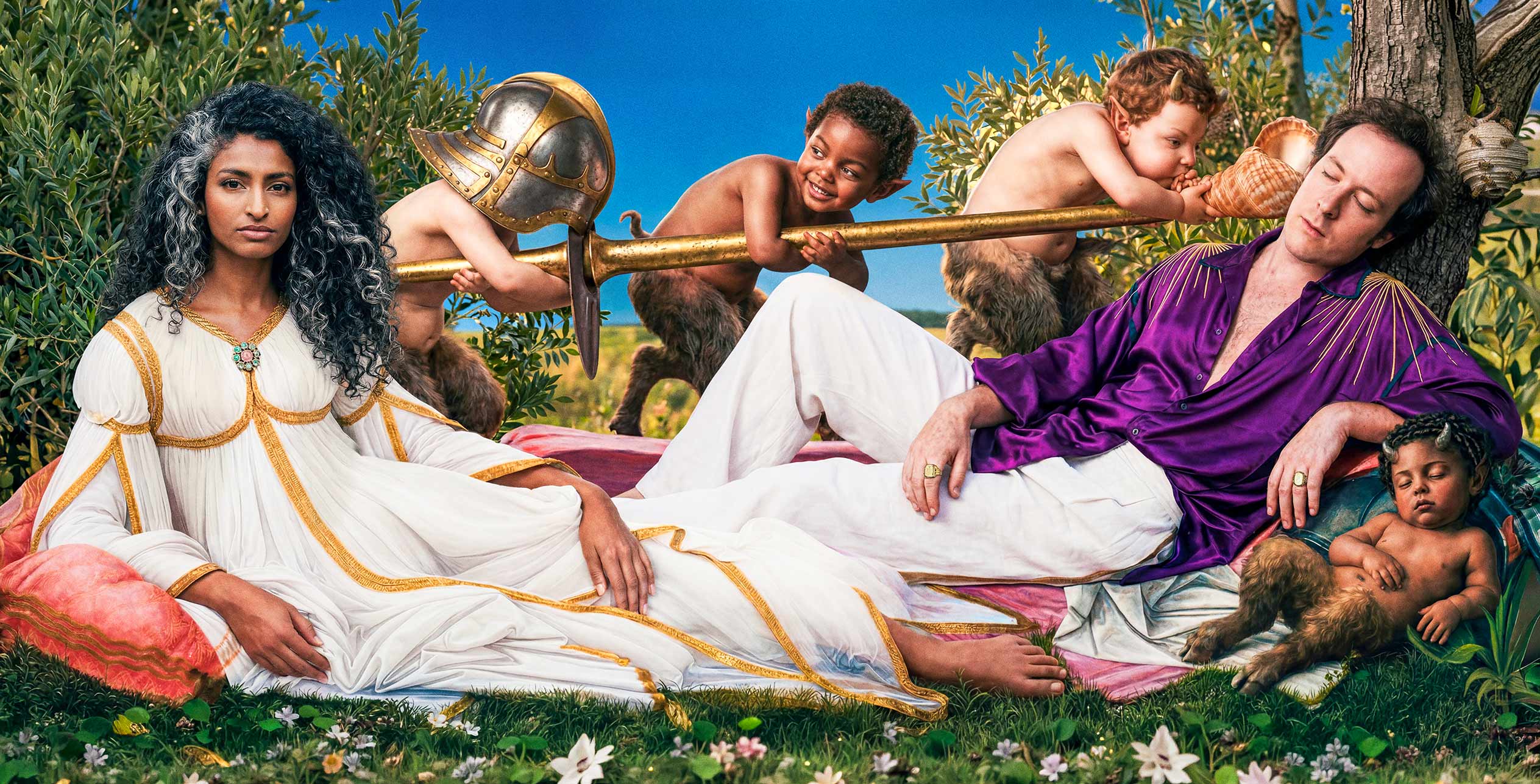
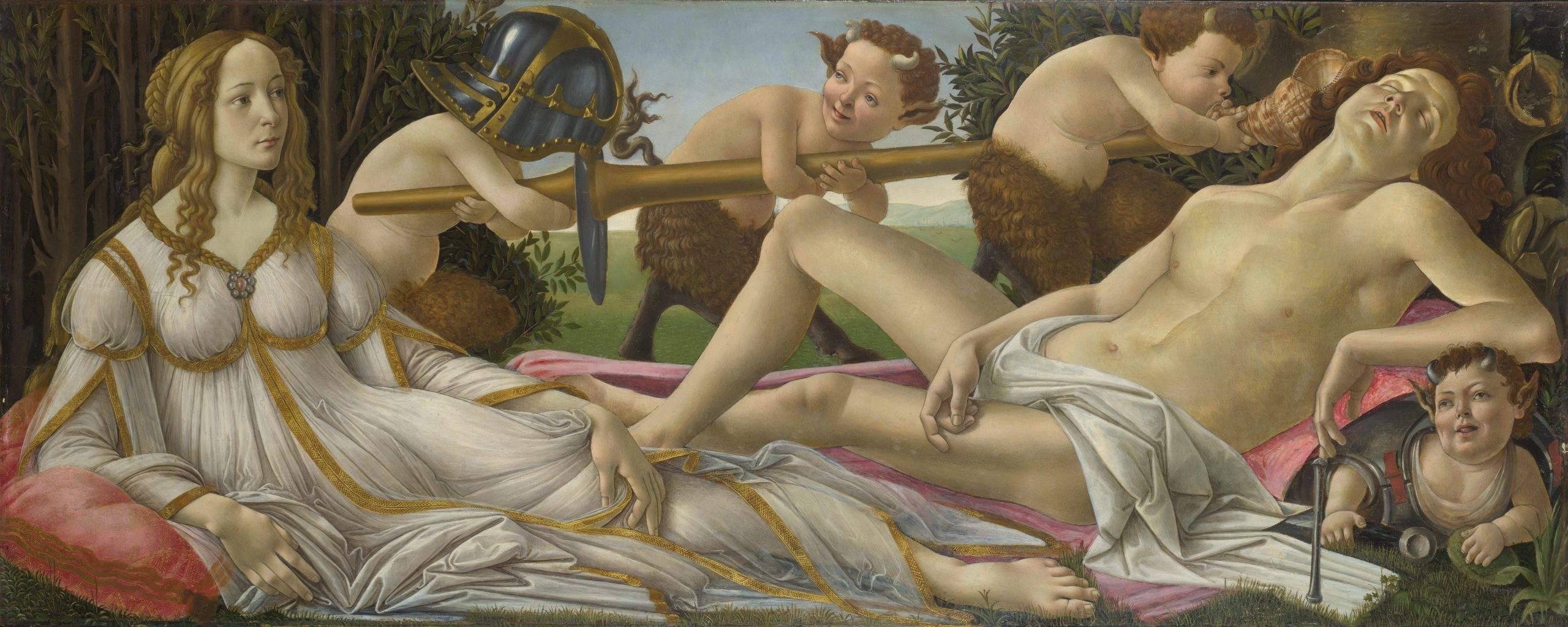
At the heart of the exhibition is a re-enactment of Sandro Botticelli's »Venus and Mars« (c. 1485). Lavanya Honeyseeda and Tim Ra bring the Renaissance classic into the present. Mars has lost his way in the Forest of Venus and fallen asleep. Frivolous satyrs turn his weapons of war into toys, while Venus watches — not as a gentle goddess of peace, but as mistress of a living world whose power is greater than any army. Botticelli's painting tells of love overcoming war. The re-enactment carries this thought further, transforming the garden of Venus into an untamed forest.
The hierarchy of the original is shifted here. Botticelli's fair, otherworldly Venus becomes the dark-skinned peace envoy Lakhura, embodied by Indian-German artist Lavanya Honeyseeda. She meets the viewer with a calm, direct gaze. Tim Ra appears as Mars — not as a triumphant god of war, but as someone asleep, disarmed, and vulnerable. The satyrs, too, are deliberately cast with different skin tones. The result is not a historical quotation, but a contemporary image of a plural humanity.
As Lakhura, Honeyseeda channels the healing power of Venus. She holds the space in which Mars comes to rest. Peace appears here not as victory over an enemy, but as the ability to strip violence of its logic. The Forest of Venus thus becomes an emblem of an order founded not on dominance, but on relationship and connectedness.
Yet the true protagonists of the image are the satyrs. They laugh and play, stealing the weapons of the god of war and stripping them of their purpose. This is precisely where the artistic gesture of this work lies: the canon is not discarded, but playfully appropriated. In ancient theatre, tragedy was followed by the satyr play — a coarse afterpiece that dissolved tension into laughter. Here, the tragedy of war is countered with the satyr play. It is not counter-violence that ends war, but its disenchantment: where weapons become toys, they lose their mythic power.
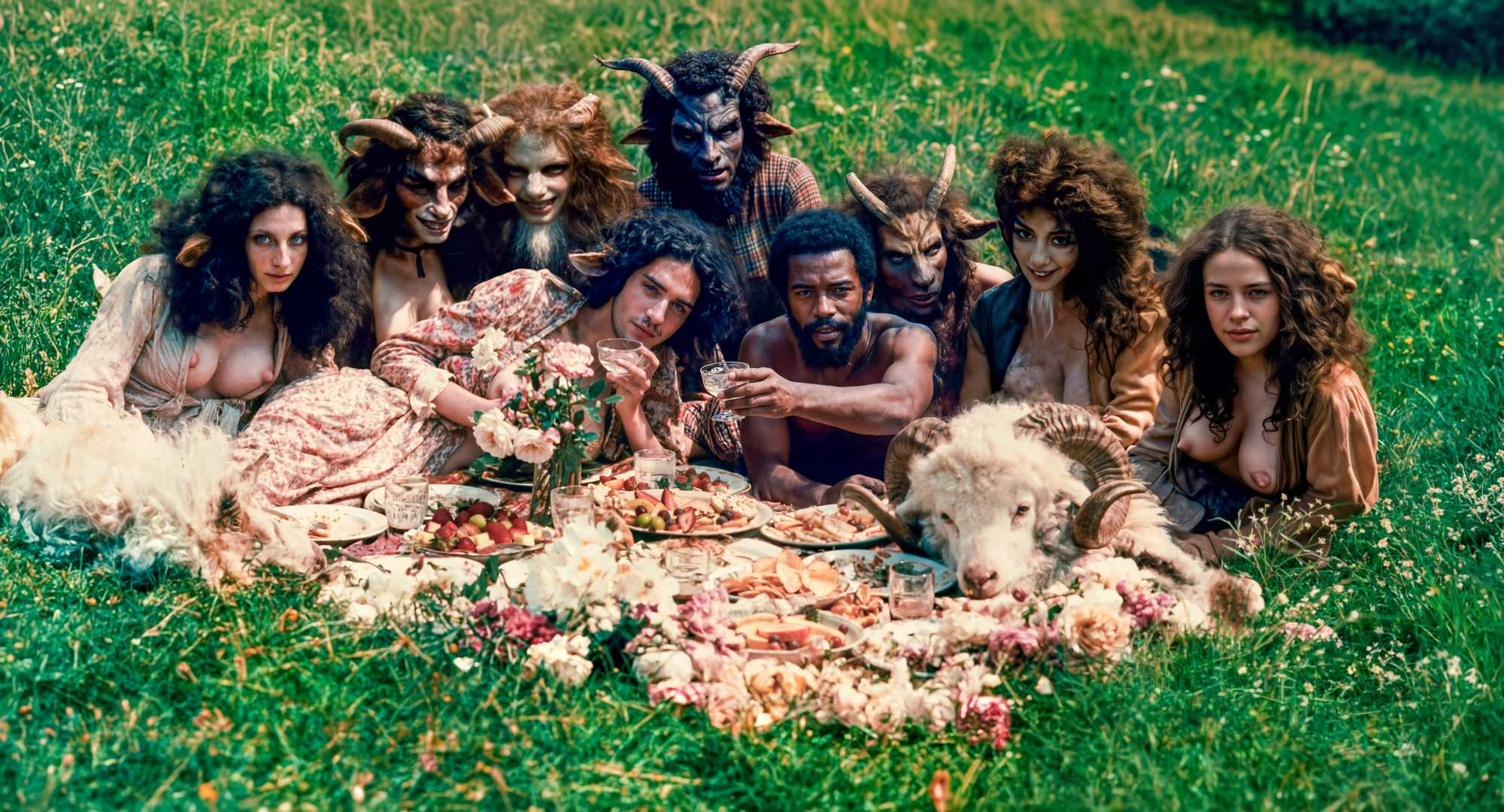
»Symposium«
In a clearing in the Forest of Venus, a party has gathered for a picnic. Nine figures sit in the lush grass: some entirely human, others with curved horns, goat ears, or fur — satyrs, fauns, and elves. Almost all of them look directly at the viewer; two of them raise their cups, as if their toast were meant for us. In Greek, "symposium" denotes a shared drinking gathering; in Plato's dialogue of the same name, the subject is Eros. Here, peace appears as lived hospitality — the raised glass is the counter-image to the raised weapon.
»Venus Matinee«
Within »Venuswald«, the video clip »Venus Matinee« marks the transition from myth to institution: it asks what a civilization could look like if founded on the principles of the Forest of Venus. A video still from the work — »The Kiss« — is currently on view at the Staatsbibliothek zu Berlin.
By loading the video, you agree to YouTube's privacy policy.
Learn more
By loading the video, you agree to YouTube's privacy policy.
Learn more
By loading the video, you agree to YouTube's privacy policy.
Learn more
Events in this Dream
World Peace Conference documentary, Lakhura performance, and new works — the opening of DREAM 6.
How do anger and pain transform into connection and creativity? The Lovelab becomes an experimental lab for empathy with ceremonial cacao & sparkling wine on ice. Featuring music & art by Saskia Baumgart, Lavanya Honeyseeda & Tim Ra, and a film by Stefanie Müller. On August 29th starting at 7 PM.
The Earth as mother and as lover. Dorothée Jansen and Sasperella La Sirène dedicate themselves to the intimate relationship with our home planet. Honey is at the center — as a natural product, food, and gift of the bees.